PROJECT 02
Speed-Dependent Control of Robotic Gripper for Tomato Harvesting to Minimise Compression-Induced Damage
Status: Biosystems Engineering — Under review.
How does the rate of force application during gripping affect tomato tissue response? This research connects robotic manipulation, force sensing and hyperspectral imaging to examine compression damage that becomes apparent after handling. The work provides experimental evidence for considering loading rate alongside peak force when designing robotic gripping strategies.
Materials & Methods
The experiments used detached standard-sized and cherry tomatoes under controlled laboratory conditions to relate gripping mechanics to delayed tissue response.
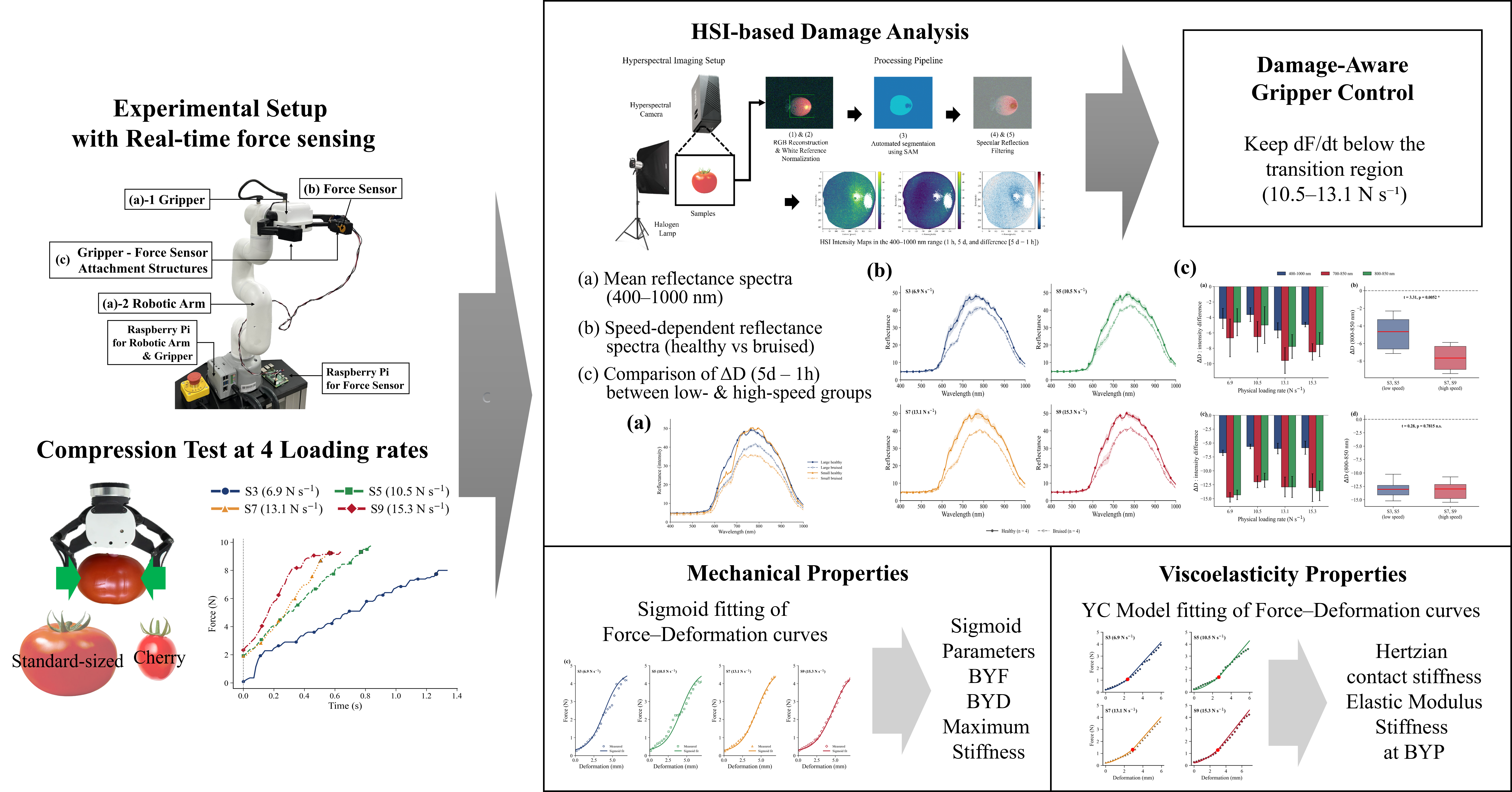
Robotic platform and force acquisition & compression test
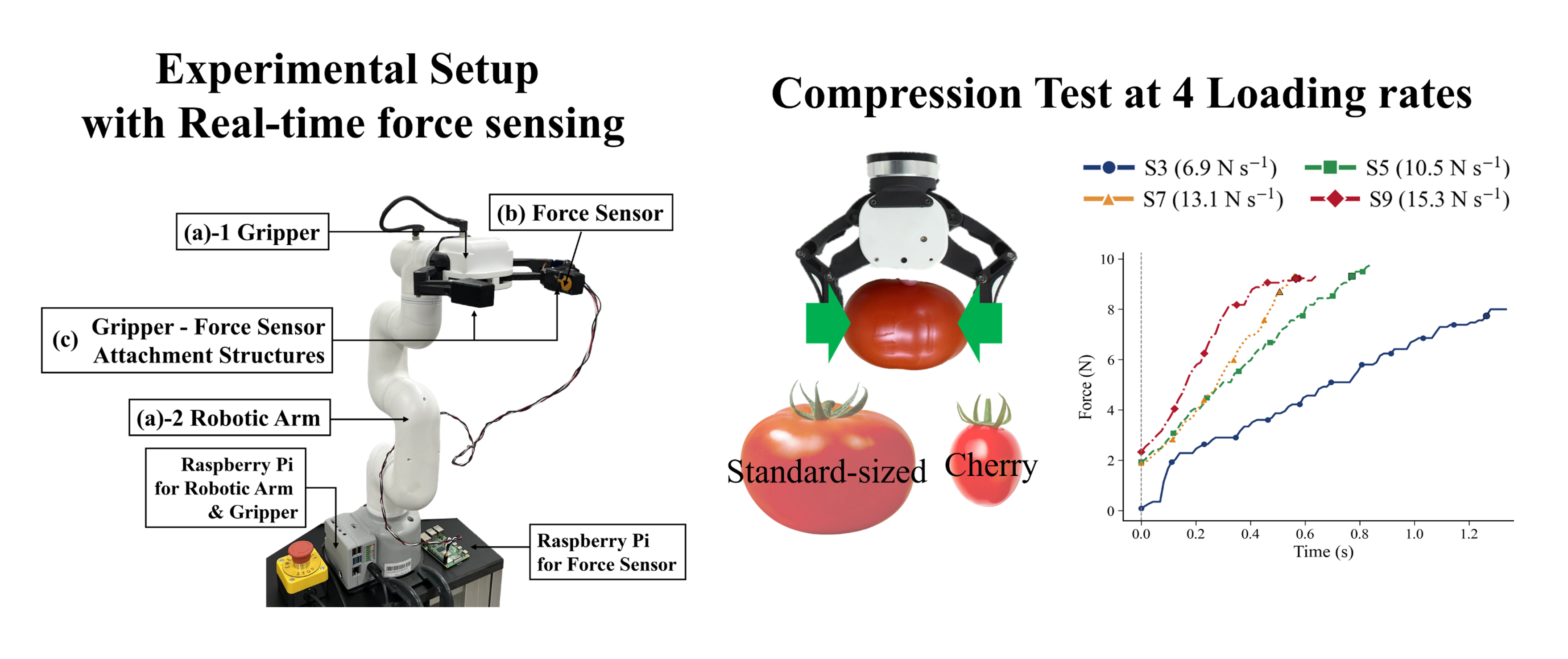
Robotic platform and force calibration
The platform combined a six-degree-of-freedom myCobot 320 for Pi arm with a myCobot Pro Gripper, controlled in Python. Custom 3D-printed PLA fixtures seated a 15 mm capacitive force sensor flush with each contact surface. A 4.5 N SingleTact sensor captured low-force mechanical responses; a 45 N sensor was used to measure loading rates and assess damage under higher gripping loads. Sensor data were acquired through I²C, and gripper-opening data were logged through MQTT.
Both sensors were calibrated with standard weights. Digital output was converted to force using the manuscript’s calibration equation:
Here, DO is the measured digital output, BO is the baseline output, DR is the effective digital range, and FSR is the full-scale rated load in newtons. Calibration gave R² = 0.988.
Controlled compression
Detached standard-sized tomatoes (60–63 mm equatorial diameter) and cherry tomatoes (29–35 mm) were gripped symmetrically across their equators. The gripper closed from its fully open position to a size-group-specific target opening. Opening ratio R (%) was converted to distance X (mm):
The opening range was 0–90 mm. Compression tests used 10 repetitions per speed condition and size group. For mechanical analysis, force and opening measurements recorded at 0.1 s intervals were synchronised by interpolation to 0.01 s intervals. Contact onset was defined at F > 0.2 N; deformation was calculated as δ = X₀ − X, where X₀ is the opening at contact onset.
Physical loading rate
Loading rate describes how quickly force accumulates in the fruit, rather than the closing velocity of the gripper. For its measurement, the 45 N sensor recorded force at approximately 70 Hz, from first contact through the force plateau and a 10 s hold. An 11-sample centred rolling median suppressed spikes before central finite-difference differentiation:
F̃ denotes the smoothed force. The reported loading rate was the mean positive derivative from first contact to 90% of the baseline-to-plateau force rise, after trimming the upper 1% of values. Three replicates were measured per setting; values deviating by more than 25% from the replicate median were excluded. This loading-rate measurement was separate from the 10-repetition compression tests.
| Setting | Closing velocity (mm/s) | Mean loading rate (N/s) |
|---|---|---|
| S3 | 10.5 | 6.9 |
| S5 | 17.8 | 10.5 |
| S7 | 25.1 | 13.1 |
| S9 | 32.1 | 15.3 |
The resulting force–deformation curves were fitted with a four-parameter sigmoid model and an extended Yigit–Christoforou contact model. These mechanical measurements were then compared with delayed hyperspectral changes, rather than treated as direct measurements of tissue damage.
Hyperspectral measurements
Hyperspectral images were collected 1 hour and 5 days after compression. The Python processing pipeline combined RGB reconstruction, reference normalisation, Segment Anything Model segmentation and paired regions of interest. Comparing the contacted region with adjacent reference tissue on the same fruit helped account for differences between individual tomatoes. The same regions were used at both observation times.
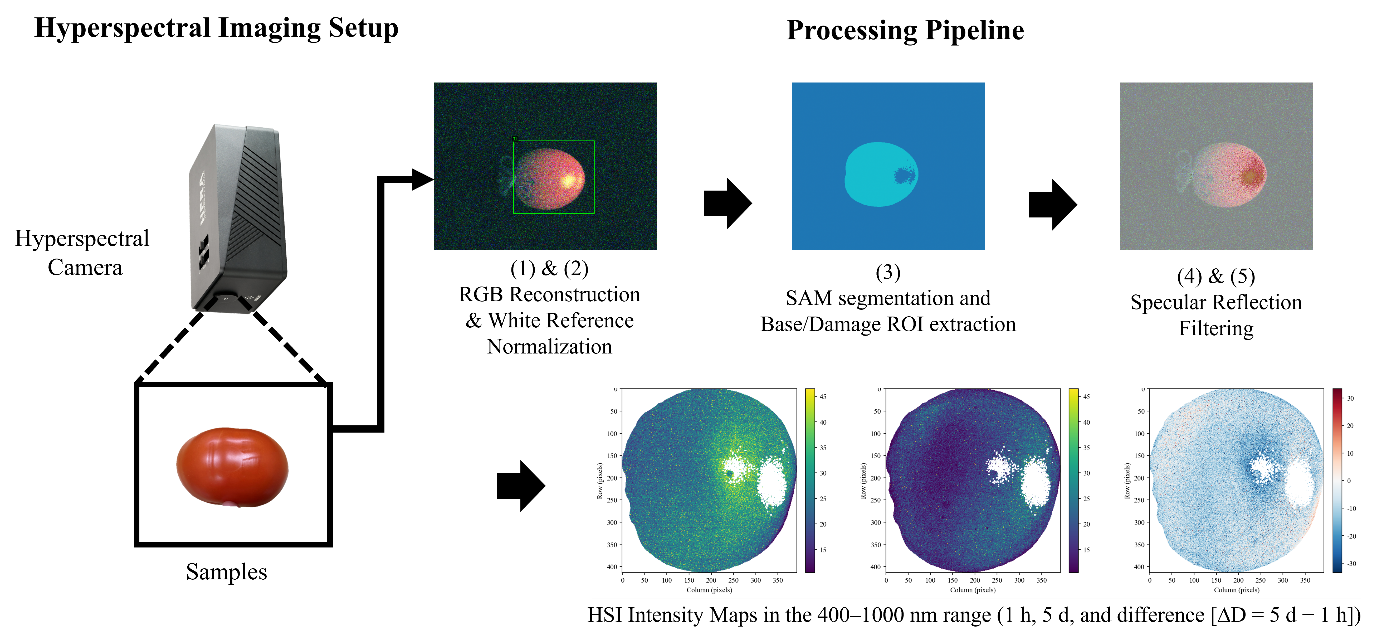
The same contact and reference regions were compared at 1 hour and 5 days after compression. This paired design separates changes at the gripper contact from changes in nearby tissue on the same fruit. The difference-in-differences indicator, ΔD, captures delayed spectral change: more negative values indicate greater reflectance loss at the contact region relative to the reference. The images illustrate the measurement workflow; group comparisons are shown in Figure 8.
Results
Loading-rate response differs between tomato size classes
Figure 7 · Spectral responses by tomato size class and loading rate
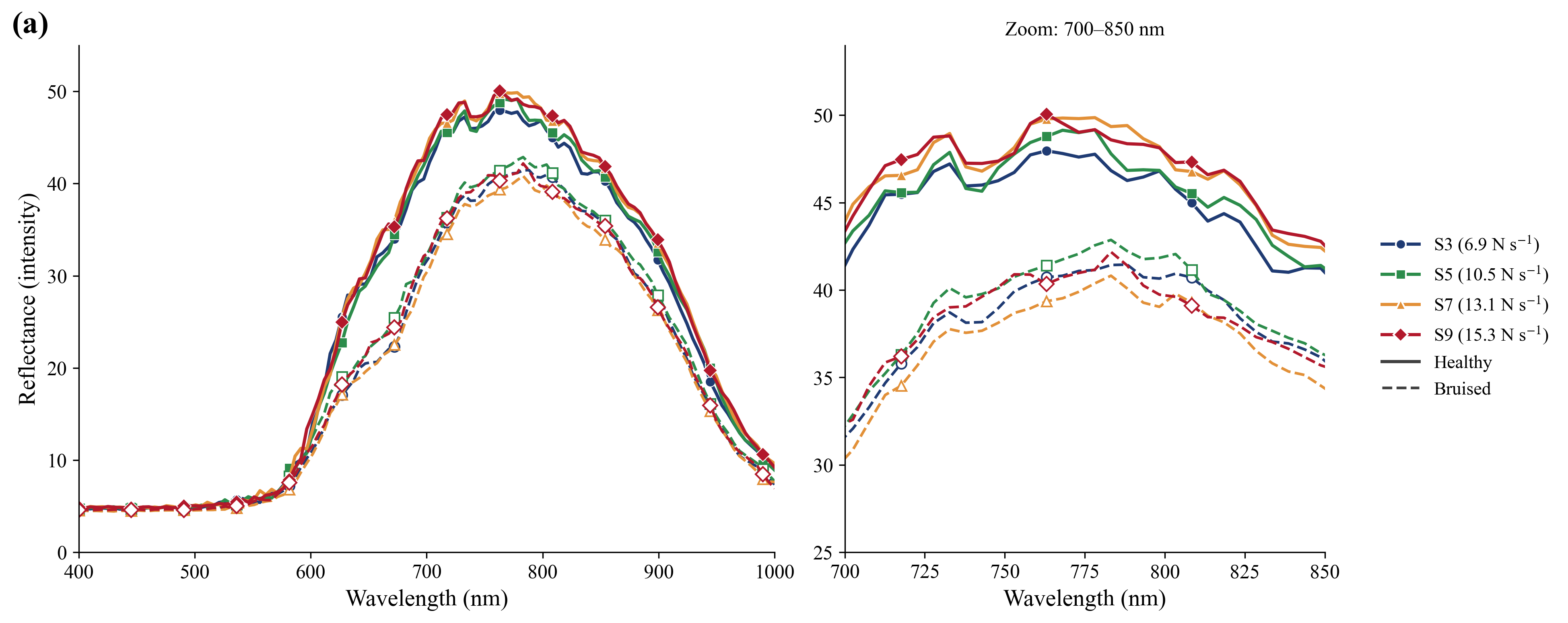
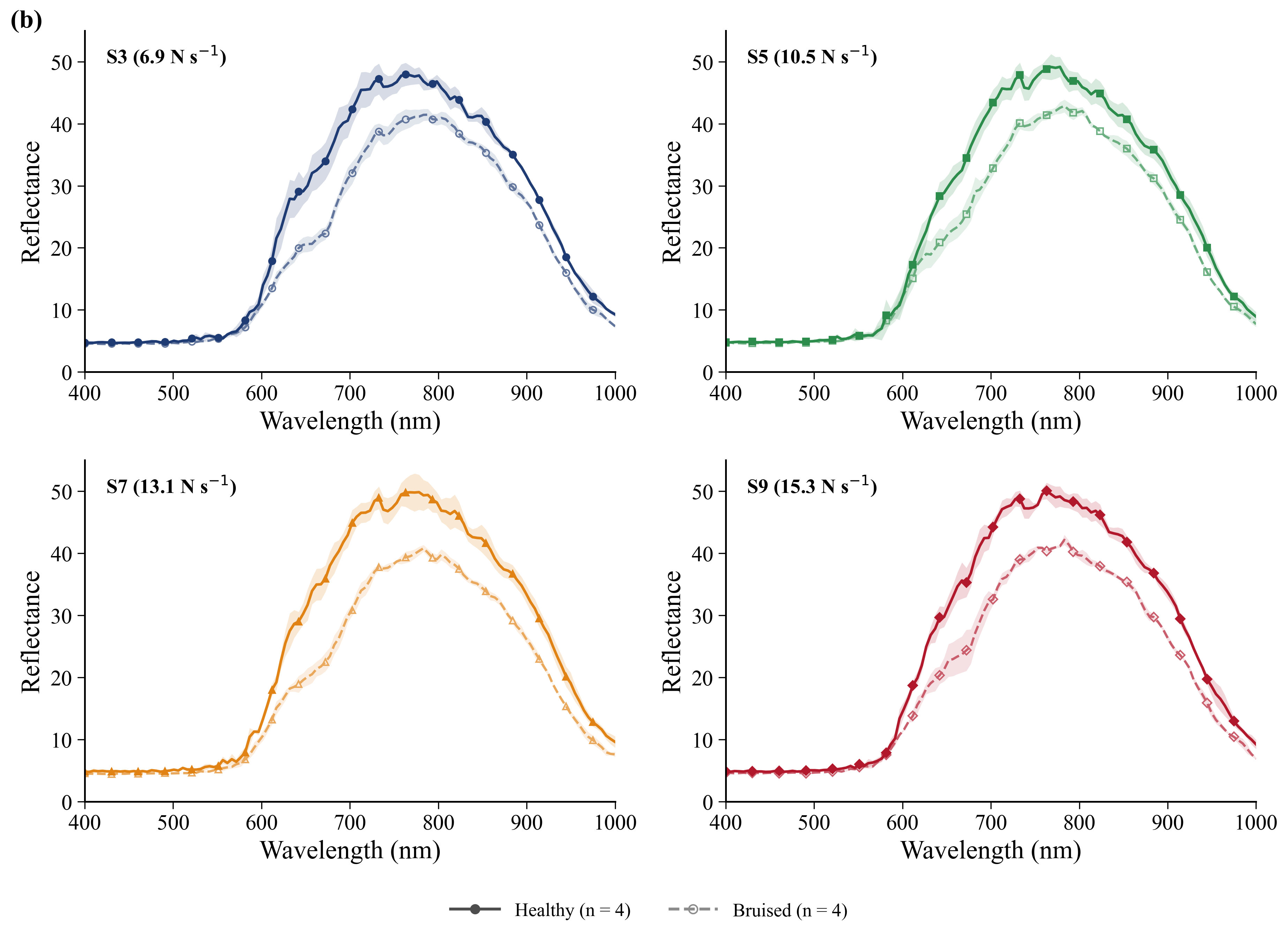
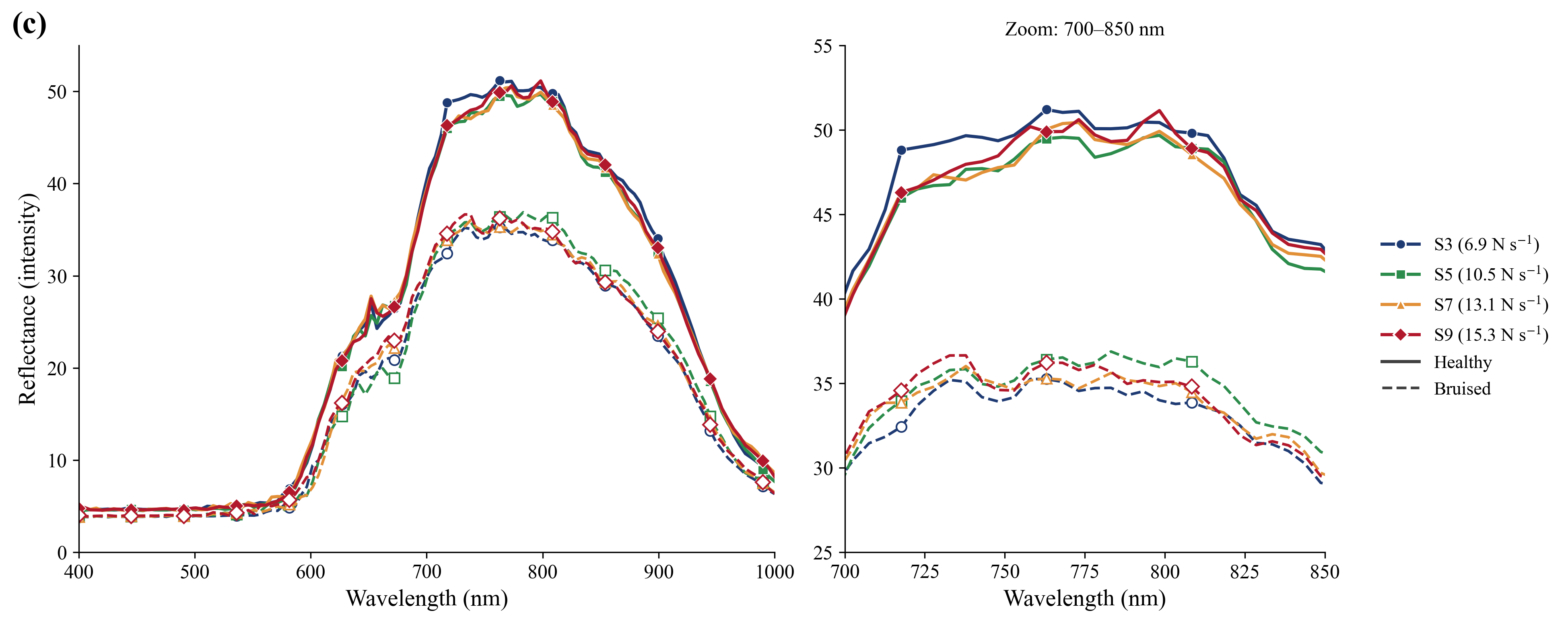
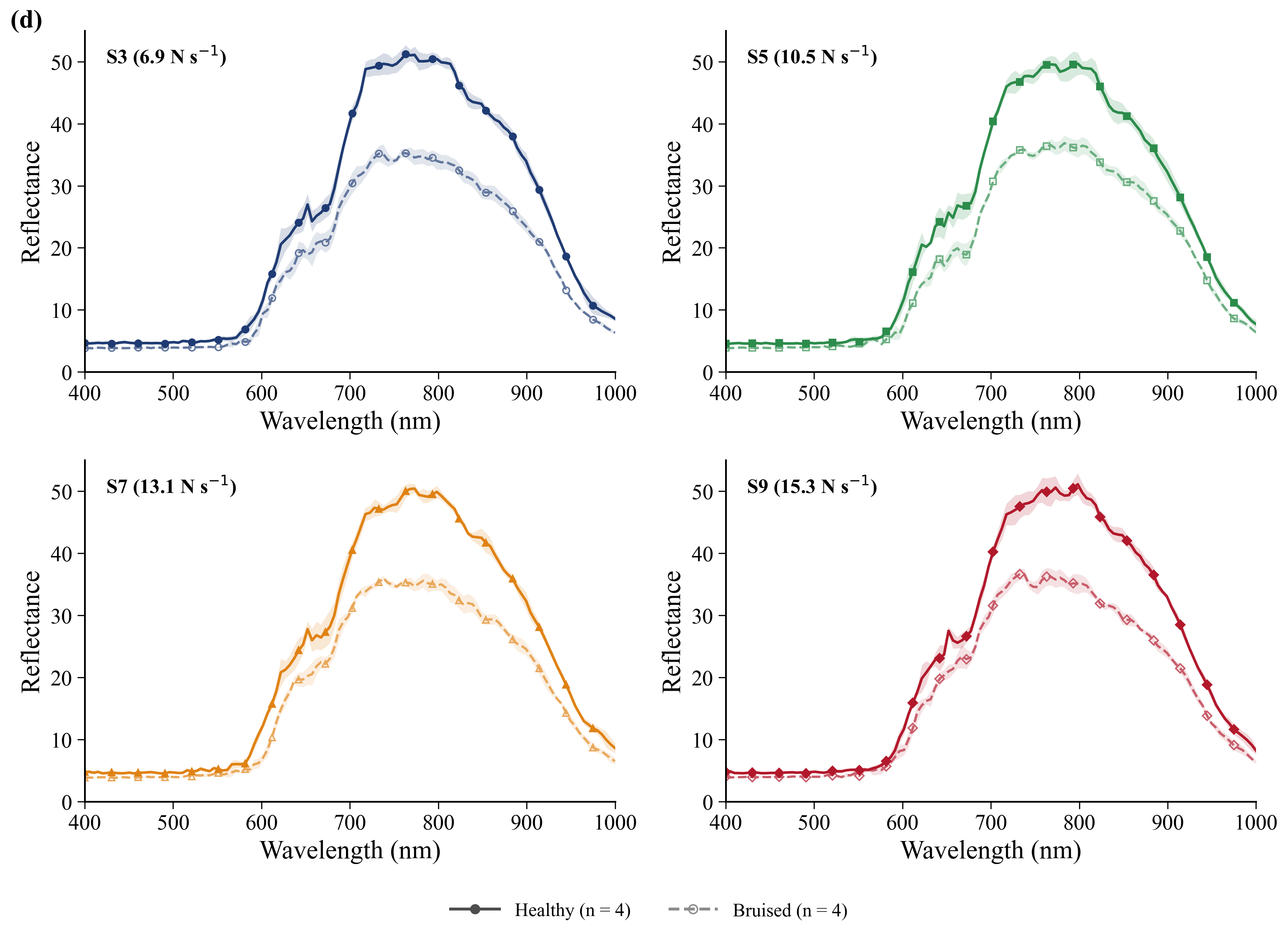
Solid and dashed curves compare reference and contacted tissue over 400–1000 nm. Standard-sized tomatoes show greater spectral separation as loading rate increases, particularly in the near-infrared region. Cherry tomatoes show a large separation across the tested rates, with less differentiation between loading conditions. The two size classes therefore did not respond to the same loading-rate changes in the same way.
Higher loading rates increase delayed spectral loss in standard-sized tomatoes
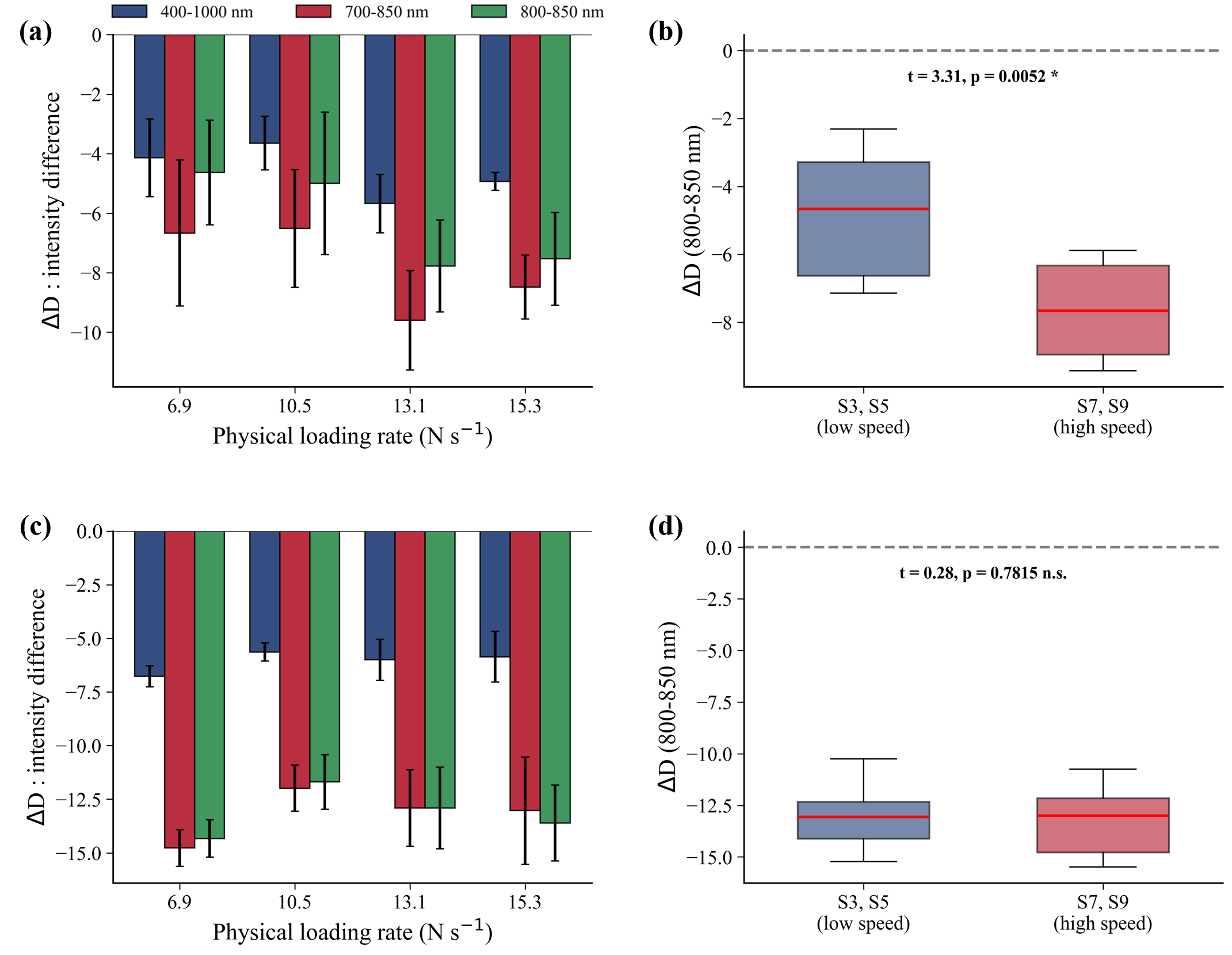
For standard-sized tomatoes, the higher-loading-rate group showed a more negative delayed spectral indicator in the 800–850 nm band (t = 3.31, p = 0.0052). Cherry tomatoes showed no significant low–high group difference (p ≈ 0.782). The apparent transition between 10.5 and 13.1 N/s supports evaluating loading-rate limits alongside peak force for this gripper and fruit condition; four tested rates do not establish a universal safe threshold.
The accompanying sigmoid and extended contact-model fits achieved R² > 0.98 for the measured force–deformation curves. These values describe mechanical model fit, rather than the accuracy of damage prediction.
The study used one cultivar per size class and a single gripper configuration. Damage assessment relied on spectral indicators. Broader validation across cultivars, maturity stages and field conditions is needed before generalising the findings.
Research output
Speed-Dependent Control of Robotic Gripper for Tomato Harvesting to Minimise Compression-Induced Damage
Seokyung Park, Jisu Song, Hyeonjun Hwang, Gunhui Park and Jaesung Park.
Biosystems Engineering — Under review.